Associate Degree in Data Science

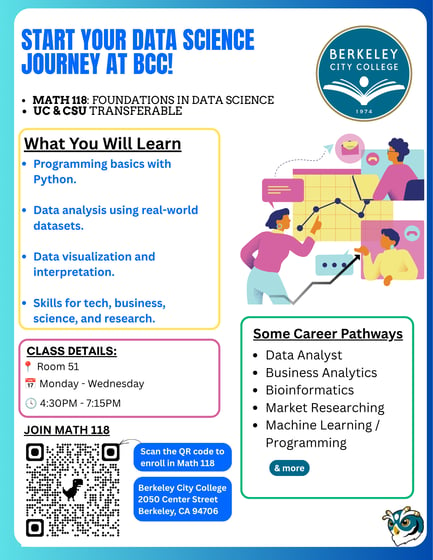
math 118 Flyer

Associate Degree in Data Science

The Associate Degree in Data Science provides students with a strong foundation in mathematics, statistics, programming, and data analysis. The program is designed primarily for students who plan to transfer to a four-year university and continue their studies in Data Science or related disciplines.

Students build analytical and computational skills through coursework in calculus, linear algebra, programming, databases, and statistical reasoning. The curriculum emphasizes both technical proficiency and the responsible use of data, including awareness of issues related to privacy and bias.

What You Will Learn

Students completing the degree will be able to:

  • Apply concepts from calculus, linear algebra, probability, and statistics to data science problems
  • Use programming and data analytics tools to make statistical inferences from data
  • Analyze and communicate data using graphs, tables, and other representations
  • Evaluate data critically while considering issues of ethics, privacy, and bias


Transfer Preparation

This degree is designed to support transfer preparation in fields such as:

  • Data Science
  • Statistics
  • Computer Science
  • Mathematics
  • Business Analytics
  • Economics
  • Social Sciences
  • Natural Sciences

The program combines mathematical rigor with computational training, preparing students for upper-division coursework and future careers in data-driven fields.

Sample Coursework

Students in the Associate Degree in Data Science build a strong mathematical and computational foundation through courses such as:

  • Calculus I (MATH 003A)
  • Calculus II (MATH 003B)
  • Linear Algebra (MATH 003E)
  • Foundations in Data Science (MATH 118)
  • Spreadsheet Applications I (CIS 042A)
  • Introduction to Computer Science or Introduction to Computer Programming (CIS 005 or CIS 006)
  • Data Structures and Algorithms or Database Programming (CIS 027 or CIS 084)

Students also complete additional coursework in areas such as statistics, economics, environmental science, bioinformatics, formal logic, research methods, and advanced programming. The degree includes 36–40 units in the major and is designed to prepare students for transfer to four-year universities.